Personalized weighted bins · first offering
Their name on the side. Real weight in the base.
You order online: pick a size and a name, monogram, or short message. I 3D-print the shell, cast a weighted base into it, and ship one named bin, heavy at the very bottom so it does not tip, get knocked over, or blow away. The body stays hollow and holds whatever the room needs.
This is a brand-new offering. One person makes these. Nothing has been cast or shipped yet. If you order, you are the first. There is no shop behind this, no queue, no reviews to read.
The 3D-printing engine underneath is real and already running on other objects (proof linked below). The weighted-bin product is a beginning, not a business, and the pour itself, casting the base, has not yet been physically proven. I would rather you know that before you write than feel misled after.
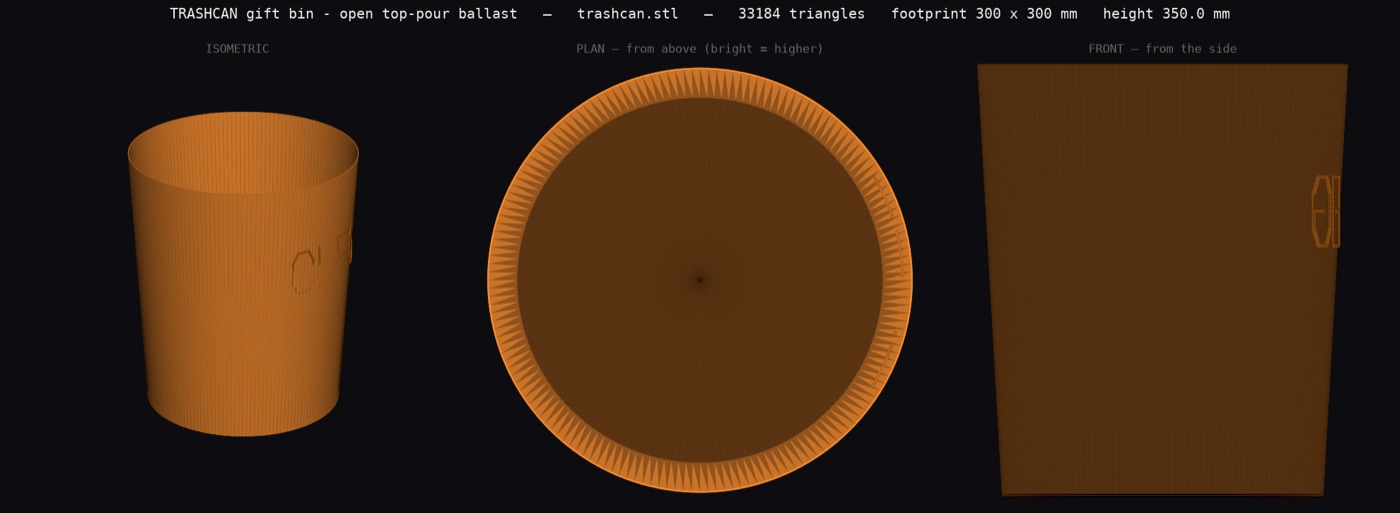
Provenance: verified 2026-08-04. The image names its own source across the top: trashcan.stl at 33,184 triangles, 300 x 300 x 350 mm. It was drawn by tools/render_stand_stl.py in the public crackle repository, and re-running that script against the current build file reproduces this image, checked pixel against pixel on 2026-08-04. Extracted from the page into a file on 2026-08-04.
A named object that stays put
A bin is the most honest gift furniture there is: used every day, in plain sight, and almost nobody buys a good one for themselves. This one carries their name as raised lettering cast into the side, part of the object rather than printed on it, and a cast base heavy enough that it stays exactly where they put it. Bump it in passing and it rocks back instead of falling over.
That makes it a gift that lands: a named bin for a kid's room, a desk-side piece for an office or studio, a housewarming object that feels premium the moment they lift it. And because the body is a hollow shell, it holds more than trash:
How an order works
Render-first, always. Nothing gets made until you have seen a render of your bin and said yes. No money changes hands before that.
- 01Tell me the size, the name or message, and where it will live.Rough height is enough. Where it lives matters because of the indoor limit below.
- 02I design it and show you a render and a price.The render is generated from the actual build file, so what you approve is what prints.
- 03You approve before anything is made.You owe nothing at this point. If it is not right, we change it or drop it.
- 04I print the shell and pour the weighted base into it.A thin tapered printed shell, open at the top; the gypsum and sand ballast goes in through that opening and sets as a slab on the base.
- 05It ships.One named bin, with the render beside it so you can check the object against the plan.
How it's actually made
The shell is 3D-printed as a thin tapered wall, open at the top. It is the same continuous-line engine behind alien.tech.senku.im, already running on other objects, and here the print is not just the surface: it is the mould.
The bin prints as one open piece, no internal cavity. The ballast, a gypsum and sand mix, is poured onto the base through the open top and sets as a slab across the floor. All the dead weight sits at the very bottom: a low center of gravity, which is exactly what makes a bin hard to tip. An optional printed cover disc drops in on top of the set slab.
The name or monogram is raised lettering formed by the print itself, part of the object, not a sticker or an engraving after the fact. It is parametric: change the text and the whole build file regenerates around it.
Because the object is drawn as code, the render you approve is generated from the actual build file, not a marketing mockup. What you approve is what prints.
The weighted base, in numbers
More pour depth means more cast mass and a steadier bin. These figures come from slicing the emitted build file itself (the default bin: 260 mm floor, 300 mm rim, 1.2 mm wall) at 1.9 g/cc for the sand and gypsum mix, crosschecked against the analytic volume to within 0.5%. No base has been poured yet: this is geometry, not a weighed part.
| Pour depth | Volume | Cast mass added | What that buys you |
|---|---|---|---|
| 20 mm | 1.05 L | about 2.0 kg | a desk-side bin that does not slide or tip when bumped |
| 40 mm | 2.12 L | about 4.0 kg | the likely default, and what the cover disc is sized for |
| 70 mm | 3.77 L | about 7.2 kg | umbrella-stand and planter territory, plants itself and stays |
The limits, plainly
Two things you should know before ordering, stated here rather than in fine print.
Gypsum is brittle and water-soluble. So these are indoor bins by default. If yours will meet water (a planter sleeve, a damp doorway), the printed shell must be the wet-facing surface and the cast gets sealed, and that is a decision we make at step 01, not a patch later.
The cast mass sits in the base slab. The body above it is a light printed shell: sturdy for trash, umbrellas, or a pot, but it is not solid stone and this page will not pretend it is.
What's proven, and what isn't
The rule on everything I publish: you should know the real stage at a glance, not after you have committed. So here it is, split honestly.
✓ Proven, and in use today
- The continuous-line printing engine, running on other objects now at alien.tech.senku.im.
- Parametric name-casting: the object is drawn as code, so the render you approve is the actual build file.
- Casting mass into printed formwork, used on other parts being built.
- The engine and its measurements are public and free to copy at take.senku.im.
○ Not proven yet, said plainly
- No bin has been cast or shipped. No customer has received one.
- The pour itself, the weighted base in a bin shell, is untested. The first casts will teach it.
- The indoor and sealing limit is a real constraint, not a footnote.
- No price list, because there is no track record to base one on. Quoted per piece.
- Lead time is a genuine estimate, not a history.
Be the first order
There is no cart and no checkout. On purpose. Tell me the size, the text, and where it will live, and I will come back with a render and a price before you owe anything.
You would be the first. If your bin needs something I am not ready to do well yet (an outdoor life, a size past my printers), I will say so plainly rather than take the order.
Goes to Oleg directly. No list, no auto-reply, no obligation.